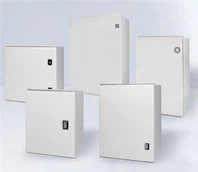
Research on Anti-Corrosion Technology for Electrical Boxes in the Power Industry: Scene Adaptation
As terminal power distribution equipment in the power system, the anti-corrosion performance of electrical boxes directly affects power supply reliability. A systematic anti-corrosion technology scheme should be constructed from three aspects: scene requirements, process selection, and effect verification, targeting the corrosion characteristics of different service environments.
I. Anti-Corrosion Performance Requirements for Differentiated Scenarios
(1) Outdoor Atmospheric Environment
Outdoor electrical boxes in urban and rural areas face temperature-humidity cycles, ultraviolet (UV) radiation, and acid rain erosion (pH ≤ 5.6), with an annual average corrosion rate of approximately 0.05–0.1 mm/year. The anti-corrosion system must 具备:
① Weather resistance (ΔE ≤ 5, GB/T 1766);
② Water resistance (no blistering after 2000h, GB/T 1733);
③ Surface hydrophobicity (contact angle ≥ 90°) to resist chemical erosion by atmospheric pollutants (SO₂, NOₓ).
(2) Coastal Salt Fog Environment
Within 5 km of the coastline, the salt fog sedimentation amount is ≥ 500 mg/(m²·d), with Cl⁻ concentration 20–50 times higher than inland areas, prone to galvanic corrosion. Requirements include:
① Salt fog protection grade (NSS test ≥ 1000h, GB/T 10125);
② Cathodic protection effect (galvanized layer thickness ≥ 85μm, GB/T 13912);
③ Coating porosity ≤ 5% (ASTM G102) to block Cl⁻ penetration paths.
(3) Industrial Corrosion Environment
Areas around chemical parks and coal-fired power plants have corrosive gases such as H₂S (≥ 10ppm) and Cl₂ (≥ 5ppm), as well as acid-base dust (pH ≤ 4 or ≥ 10), with an annual corrosion rate of up to 0.3–0.5 mm/year. Core indicators:
① Chemical media resistance (weight loss ≤ 1% after immersion in 10% H₂SO₄ for 200h);
② Wear resistance (falling sand test ≥ 5000L, GB/T 1771);
③ Impermeability (DC resistance ≥ 10⁶ Ω·cm, ASTM G59).