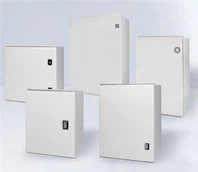
What Are the Differences Between Distribution Boxes?
As an electrical device widely used in power distribution systems of industrial facilities, buildings and public utilities, the main functions of a distribution box are to realize power distribution, control and protection. In practical applications, different types of distribution boxes vary significantly in structural design, application scenarios, protection level, material selection and internal configuration.
First of all, in terms of structural form, distribution boxes can be divided into surface-mounted type and flush-mounted type. Surface-mounted distribution boxes are usually installed on the wall surface, facilitating inspection, repair and maintenance, and are suitable for renovation projects or temporary power supply occasions. Flush-mounted distribution boxes, on the other hand, are embedded inside the wall, featuring a neat and aesthetic appearance, and are mostly used in new construction projects.
Secondly, in terms of protection level, distribution boxes have distinct IP ratings according to different application environments. For example, distribution boxes used in outdoor or humid environments need to have high dustproof and waterproof capabilities, usually meeting the IP54 standard or above. By contrast, those used in dry indoor environments can adopt a lower protection level.
In terms of materials, common shell materials of distribution boxes include metal (such as cold-rolled steel plate and stainless steel) and non-metal (such as high-strength engineering plastics). Metal materials boast excellent mechanical strength and electromagnetic shielding performance, making them suitable for high-load and strong-interference industrial scenarios. Non-metal materials, however, have outstanding insulation, corrosion resistance and lightweight characteristics, which are ideal for places with strong chemical corrosion or high requirements for electrical insulation.
In addition, the configuration of internal components is also an important differentiator. Some distribution boxes integrate components such as circuit breakers, isolating switches, surge protectors and current transformers to form a multi-functional integrated power distribution unit. Meanwhile, simple-type distribution boxes may only be equipped with basic terminal blocks, requiring additional external protection devices.
In terms of installation methods, distribution boxes are also classified into wall-mounted type, floor-standing type and rail-mounted type to meet the layout requirements of different spaces.
Finally, according to the application requirements of different industries, distribution boxes also need to comply with specific electrical safety specifications and wiring standards to ensure the reliability and scalability of the system.
To sum up, the differences between distribution boxes are reflected in multiple technical dimensions. When selecting a distribution box, a comprehensive evaluation should be carried out based on specific service conditions.