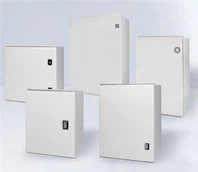
The connection method of the meter box
Usually the power transmission is in the way of three-phase four-wire. The three ends of the three-phase electricity are called the phase wires, and the three tails of the three-phase electricity are connected together and called the neutral wire, which is also called the "zero wire". The reason why it is called the neutral line is that no current flows through the neutral line at the moment of three-phase equilibrium, and it is directly or indirectly connected to the earth, and the voltage to the earth is also close to zero. Three-phase four-wire system: In the low-voltage power distribution network, the transmission line generally adopts a three-phase four-wire system. If the neutral point is grounded, the neutral line is also called the neutral line (the old name should be avoided gradually and renamed PEN). If it is not grounded, the neutral line cannot be called the neutral line in a strict sense). In the single-phase transmission line that enters the user, there are two lines, one is called the phase line L, and the other is called the neutral line N. Under normal circumstances, the neutral line must pass current to form a current loop in the single-phase line. In a three-phase system, when the three-phase is balanced, the neutral line (zero line) has no current, so it is called three-phase four-wire system; Set N line, some occasions can also be used for zero-sequence current detection, in order to monitor the balance of three-phase power supply. The transformer in the distribution room outputs three live wires and a neutral wire (grounding is also called a neutral wire). Each of the three live wires (phase wires) and the zero wire are 220v single-phase. The live wire and the live wire are two-phase (two-phase) 380v. All three live wires are used as three-phase, and every two wires are 380v. A circuit composed of a live wire and a neutral wire is called a single-phase circuit. The circuit composed of three live wires is called a three-phase circuit.
Two-phase China is not used. The three-phase five-wire system refers to the A, B, C, N and PE wires. Among them, the PE wire is a protective ground wire, also called a safety wire, which is specially used to ensure the safety of electricity use, such as equipment enclosures. The PE line is connected to the N line on the side of the power supply transformer, but it must not be used as a neutral line after entering the user side, otherwise, it will be no different from a three-phase four-wire system after chaos. Because this kind of confusion makes people lose vigilance, it may be more prone to electric shock accidents in practice. The fundamental difference between the neutral line and the PE line is that the neutral line forms a loop, and the PE line only plays a protective role. Now the power supply of civil residential houses has stipulated that the three-phase five-wire system should be used. If yours is not, you can request rectification. For safety, we must categorically require the use of a three-phase five-wire system!
Color specification
It is best to use standard and standardized wire colors in the application: A phase uses yellow, B phase uses green, C phase uses red, N wire uses light blue, and PE wire uses yellow and green. In the single-phase transmission line that enters the user, there are two lines, one is called the live line L (Line), which is brown; the other is the neutral line N (Neutral), which is light blue, and the neutral line is normal. It is necessary to pass current to form the current loop in the single-phase circuit; the other three-hole socket (zero fire on the left and ground in the middle) will have a grounding wire. Ground the shell of some electrical appliances, that is, the grounding protection wire PE, with yellow Green two-color line. Repeated grounding Regardless of N wire (neutral wire) or PE wire (protective grounding wire), repeated grounding must be used on the user side to improve reliability. However, repeated grounding is only repeated grounding. It can only be connected together at the grounding point or close to the grounding point, but it does not mean that it can be connected together at any position, especially indoors. This must be remembered! "Single-phase three-wire": live wire L, neutral wire N and ground wire GND. The voltage between L and N is 220V alternating current. That is, single-phase alternating current. The civil power supply is powered by a single-phase AC 220V voltage. "Two-phase three-wire": refers to two live wires L1 and L2 plus a neutral wire GND. The voltage between L1 and L2 is 380V alternating current.