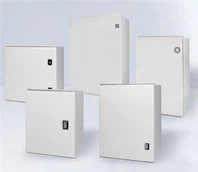
Differences Between Level 1, Level 2 and Level 3 Distribution Boxes
Functional Differences
Voltage and Protection Levels
A Level 1 distribution box serves as the "master switch" of the power distribution system, directly connected to 10kV high-voltage incoming lines (stepped down to 0.4kV via a transformer). It acts like the "brain" of the entire power supply system, controlling the on-off status of the whole system through a main circuit breaker. Equipped with high-capacity residual current protectors and overload protection devices as standard, it can cut off serious faults within milliseconds to prevent the escalation of accidents-a critical life-saving configuration in industrial settings.
A Level 2 distribution box functions as a "regional manager", connected upstream to the Level 1 box and downstream to multiple Level 3 boxes. Its protection device parameters are moderate, specifically designed to handle medium-scale faults within the region. It not only protects downstream equipment but also avoids triggering upstream tripping unnecessarily. Simply put: it resolves minor issues independently and reports major problems promptly.
A Level 3 distribution box acts as a "personal bodyguard" directly serving electrical equipment, providing precise protection for 220V mains-powered devices. Its high-sensitivity residual current protector can trip within 0.1 seconds, equivalent to equipping each device with an independent fuse, and strictly complies with the safety guideline of "one machine, one switch, one residual current protection".
Structural Differences
Capacity and Components
The interior of a Level 1 box is similar to a small substation: copper busbars ensure stable transmission of large currents; the combination of a main circuit breaker and branch circuit breakers forms a double safety barrier; and an isolation switch enables live maintenance. Its bottom-in and bottom-out wiring design, coupled with a rainproof box top, allows it to operate stably in outdoor environments-these details are highly valued by engineering personnel.
A Level 2 box features a more streamlined structure, with multiple three-phase circuit breakers arranged neatly. Its double-door design (inner and outer) facilitates daily inspections. The spray-coated shell offers both corrosion resistance and rain protection, making it suitable for complex environments such as construction sites. Maintenance does not require disassembling the entire unit, which is a very practical design.
A Level 3 box adopts a "minimalist style", mainly equipped with single-phase circuit breakers or fuses, and some models are fitted with additional residual current protection modules. All wiring terminals are designed with anti-misoperation features, enabling safe operation even for household users. After all, as the terminal directly facing end-users, it must balance safety and ease of use.
Application Scenarios
Power Supply Range and Electrical Load Types
Level 1 boxes are usually installed in the power distribution rooms of large factories and commercial complexes, with only one unit typically configured per project. Acting as the "general headquarters" of the power system, they are solely responsible for power dispatching and do not directly supply power to equipment-this design maximizes power supply reliability.
Level 2 boxes are widely used in residential communities, office buildings and other places, accurately distributing power to each floor and each area. They can power not only conventional loads such as lighting but also power equipment such as three-phase motors, serving as the backbone of the power distribution network.
Level 3 boxes cover every electrical terminal, ranging from household air conditioners to commercial freezers in shops. They strictly adhere to the principle of "one box for one device", implementing safety protection at the furthest end of the system. This is why it is emphasized that no matter how small a Level 3 box is, it must be equipped with all necessary protection functions.